Read Online
Loading Issue #25...
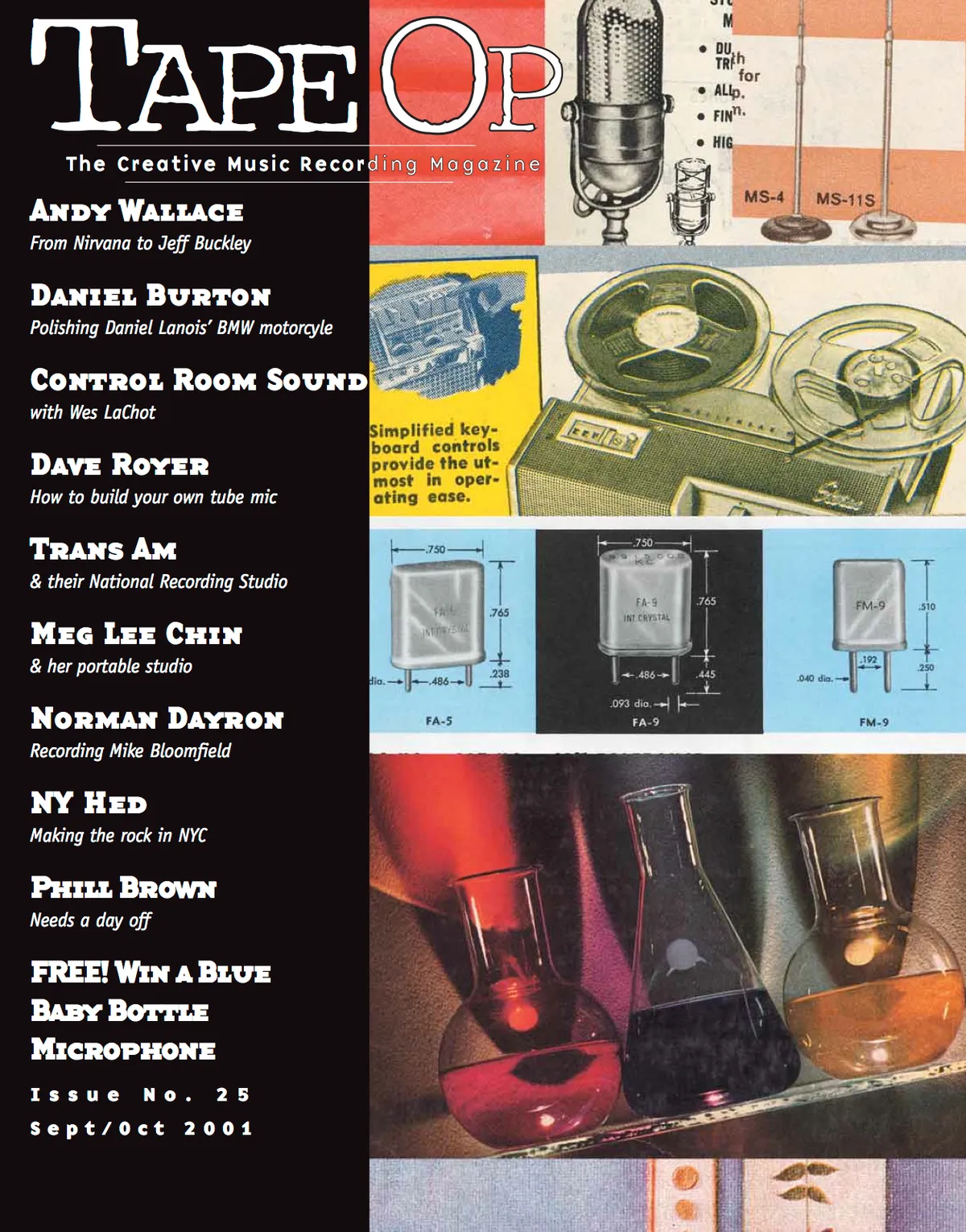
Tape Op Magazine Issue #25 Cover
Read Online

ISSUE ARCHIVE

Latest Issues

NO. 171 | Nov 2025

Tape Op Issue 171

NO. 170 | Sep 2025

Tape Op Issue 170

NO. 169 | Sep 2025

Tape Op Issue 169

NO. 168 | Jul 2025

Tape Op Issue 168

NO. 167 | May 2025

Tape Op Issue 167

NO. 166 | Mar 2025

Tape Op Issue 166

NO. 165 | Jan 2025

Tape Op Issue 165

NO. 164 | Nov 2024

Tape Op Issue 164

Sep/Oct 2001

Welcome to issue #25 of Tape Op.

Hello and welcome to Tape Op #25! I'm pleased to report that we've made it to our 25th issue and are well into our 6th year. Anyone who's been reading or involved with Tape Op from the beginning knows the changes we've gone through — from a hand-Xeroxed, collated and stapled mag in 1996, to the small press runs a few years later, and now as a bi-monthly with full-color and lots of advertisers (to whom we're very, very grateful). There are a few changes happening though. After years as the writer of "Under the Radar", Rob Christensen is stepping down (for now, as he may return) and long-time Tape Op supporter/helper Matt Mair Lowery will be taking his place next issue. So don't dismay if you miss the column this issue! The other change will be less directly visible, as we welcome Jeff Fellers as an ad sales rep, hopefully taking some of the load off of John's shoulders! The other change? I was married in August to the lovely Mrs Jane Crane. Sorry girls! Alright, let's make some %$*^! records...

Mr Larry Crane, editor


— LARRY CRANE,EDITOR & FOUNDER

Larry Crane's signature

IN THIS ISSUE

Daniel Burton
Sep 15, 2001 NO. 25 Interviews

Daniel Burton

Daniel Burton has seen it all and would rather stay home. This does not mean he is jaded or a hermit — he just knows what should be done in order to get things done. If you listen to any of his record...

Meg Lee Chin
Sep 15, 2001 NO. 25 Interviews

Meg Lee Chin: & her portable studio

Meg Lee Chin has been recording since her college days in San Francisco, when she recorded Faith No More's first ever recording on her 4-track, and the vocalist was one Ms Courtney Love! An American w...

Control Room Sound
Sep 15, 2001 NO. 25 Article
Norman Dayron
Sep 15, 2001 NO. 25 Interviews

Norman Dayron: Recording Mike Bloomfield

Twenty years after his death, the late Michael Bloomfield still exerts a gravitational pull over anyone who heard his ground-breaking blend of blues- rock guitar power and modal improvisations. That mixture captured my imagination — I can remember trying to kill time on a lengthy high school bus trip, and swapped Cream's Disraeli Gears for Nick Gravenites' My Labors, which had Bloomfield's fingerprints all over it. As I was enjoying "Gypsy Good Time", somebody piped up behind me, "Don't you have any music that isn't bizarre?" Suitably appalled, I turned around, "C'mon, man, this is your heritage! Don't you care where your Top 40 comes from?" I drew a blank stare, but I'd made my point. Bloomfield's friend, and producer, Norman Dayron, relishes the anecdote. "Michael's idea was [that], you always go back to the source — as far as you can, to the plantation sound, the work song, the prison song. He was not interested in music that was created by imitating what someone else did last week." Bloomfield practiced what he preached, shunning the major label rat-race after Super Session (1968), the jam-oriented album that became his only gold record. Instead, he focused on playing his San Francisco Bay home-turf, and recorded for small indie labels — making his work hard to find before he died of a drug overdose under murky circumstances in February 1981. Now, Bloomfield's work is undergoing a reappraisal, after a series of reissue CDs — including Live At The Old Waldorf (1998), which Dayron compiled — and a new, unflinching oral biography, If You Love These Blues (by Jan Mark Wolkin and Bill Keenom: Backbeat/Miller Freeman Books). Dayron is among numerous friends offering insight into Bloomfield's musicological bent, as well as his bouts with insomnia, addictions to heroin, and alcohol — and contrarian quirks that eventually spun out of control (such as blowing out gigs).